
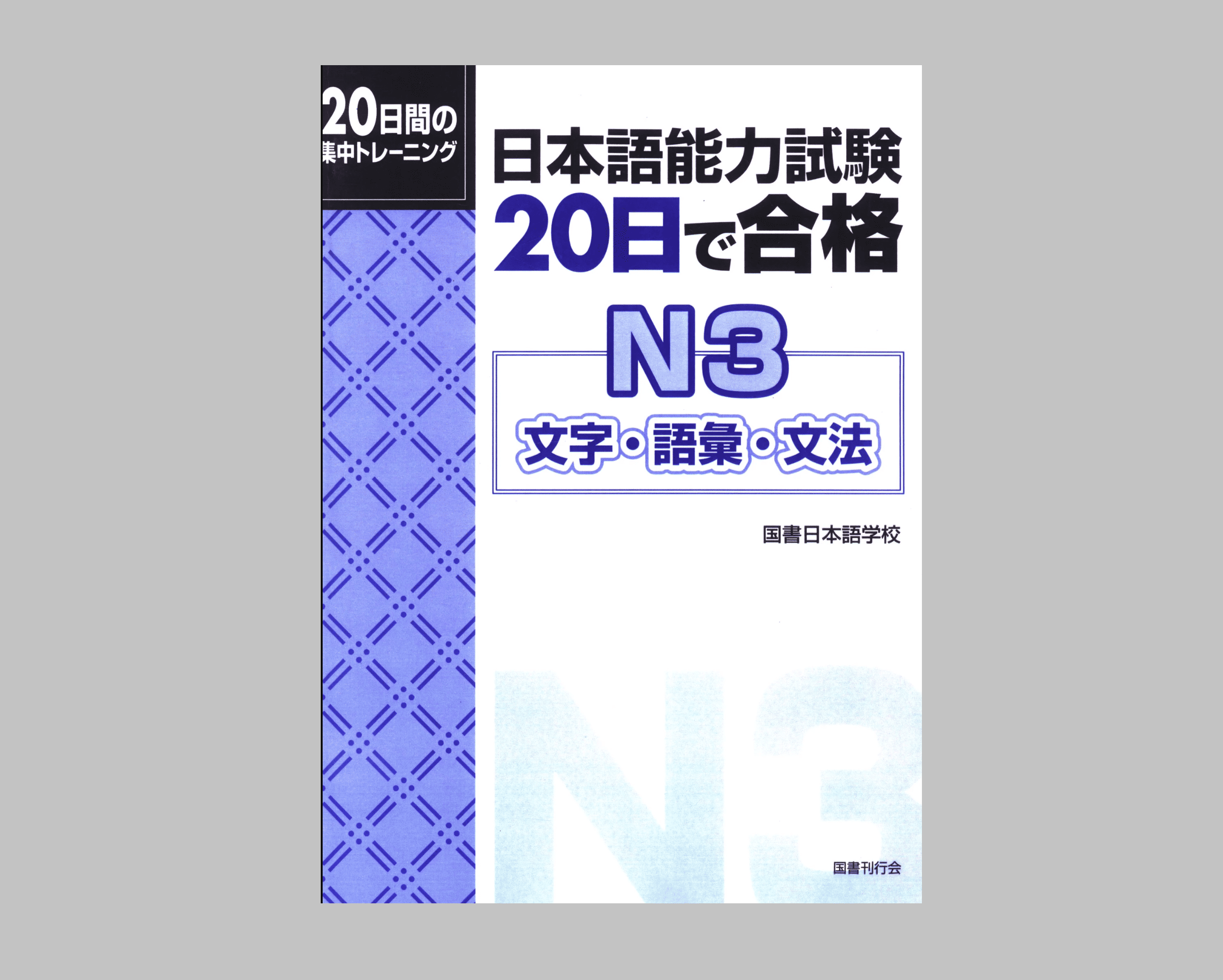
Book Pass N3 within 20 days
Password: unojapano.com
Passing the Japanese Language Proficiency Test N3 is an important achievement for learners who want to move beyond basic Japanese and begin understanding the language used in everyday life. At this level, students are expected to recognize a wider range of Kanji, vocabulary, and grammar while also reading longer passages and following conversations spoken at a more natural speed.
For many learners, the transition from JLPT N4 to N3 can feel challenging. N4 mainly focuses on basic expressions and familiar situations, while N3 introduces more complex sentence structures, abstract vocabulary, and reading passages that require a deeper understanding of context.
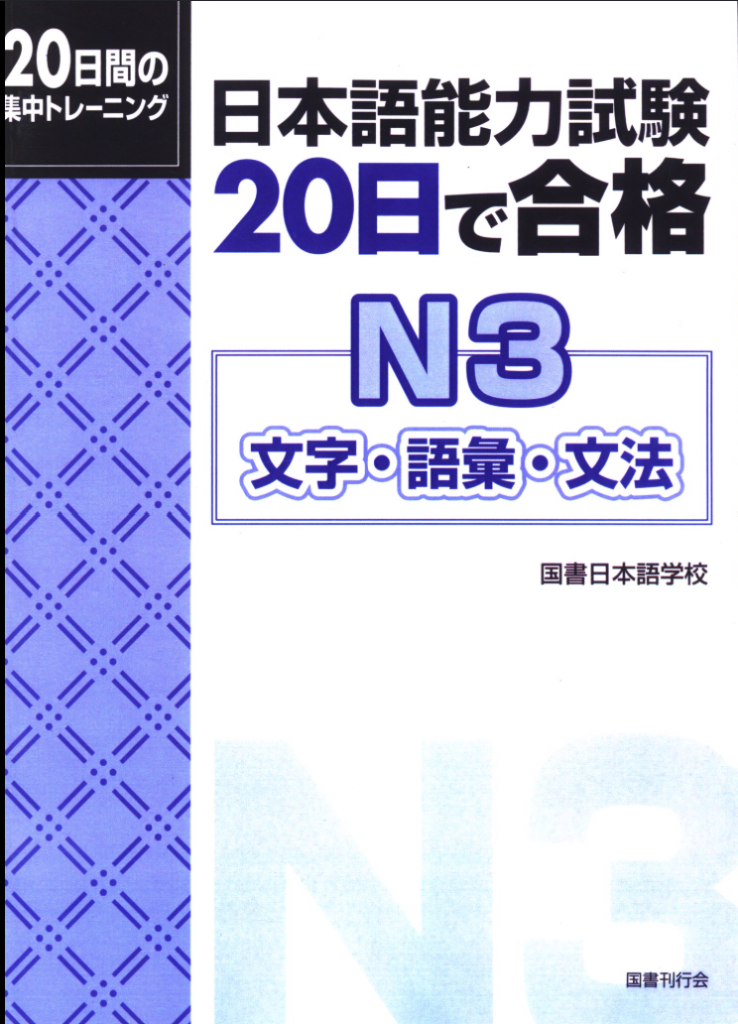
20日で合格N3, which can be translated as “Pass the JLPT N3 in 20 Days,” is designed to help learners organize their final preparation into a clear and manageable 20-day study plan.
Instead of reviewing random vocabulary lists or switching between many different resources, learners can follow a structured daily schedule. This makes the book especially useful for students who are approaching the exam date and want to review the most important N3 content efficiently.
The title does not necessarily mean that a beginner can reach JLPT N3 level in only 20 days. In most cases, learners need a solid foundation in basic Japanese before beginning intensive N3 preparation. The book is more suitable as a final review guide for students who have already studied N3-level material and want to strengthen their knowledge before the official examination.
Why JLPT N3 Is an Important Level
JLPT N3 is often considered the bridge between elementary and advanced Japanese.
At N5 and N4, learners mainly study basic vocabulary, simple grammar patterns, and familiar daily situations. At N3, the language becomes more varied and natural. Learners must understand not only the direct meaning of a sentence but also the relationship between ideas, the speaker’s intention, and the context in which an expression is used.
Reaching N3 level can help learners become more comfortable with:
- Everyday conversations in Japanese
- Basic workplace communication
- Japanese television programs and videos
- Short news reports and announcements
- Emails, notices, and simple formal documents
- Stories, essays, and explanatory passages
- Natural grammar used by native speakers
Although passing N3 does not mean that a learner has mastered Japanese, it shows that they have developed a strong intermediate foundation.
For students planning to continue to N2 or N1, N3 is also an important stage. Weaknesses in N3 grammar, vocabulary, or reading can make higher-level study much more difficult.
Why a 20-Day Study Plan Can Be Effective
One of the biggest difficulties in JLPT preparation is deciding what to study each day.
Many learners collect several textbooks, vocabulary applications, grammar websites, YouTube lessons, and practice tests. Although these resources can be helpful, using too many at the same time may lead to confusion.
A learner may spend one day reviewing Kanji, another day watching grammar videos, and the next day memorizing random vocabulary. Without a clear schedule, it can be difficult to know whether all important areas are being covered.
A 20-day study plan solves this problem by dividing the review process into smaller daily units.
Instead of asking:
What should I study today?
you can simply follow the next lesson, complete the exercises, check your mistakes, and continue to the following day.
This structure can be especially helpful for:
- Busy university students
- Office workers
- Parents with limited study time
- Independent learners studying without a teacher
- Students taking the JLPT for the first time
- Learners who need a final review before the test
Twenty days is short enough to maintain motivation but long enough to build a consistent daily routine.
Who Should Use 20日で合格N3?
This book is most suitable for learners who have already completed basic Japanese study and are preparing for the JLPT N3 examination.
It may be helpful for:
- Learners taking JLPT N3 for the first time
- Students who have completed N4-level material
- Test takers who previously failed N3
- Learners who need a structured revision schedule
- Students who understand grammar but struggle with exam questions
- Learners who want to improve reading and listening speed
- Busy people who prefer a focused 20-day program
- Self-study learners who need clear daily goals
The book may be difficult for complete beginners. Learners who are still unfamiliar with basic particles, verb forms, adjective conjugations, and N4 grammar should strengthen those areas before beginning an intensive N3 review.
What Skills Are Tested in JLPT N3?
The JLPT N3 examination evaluates several areas of Japanese ability.
The main sections include:
- Language Knowledge: Vocabulary
- Language Knowledge: Grammar
- Reading
- Listening
Each section requires a different study method.
Memorizing individual words may help with vocabulary questions, but it will not automatically improve reading comprehension. Learning grammar definitions may help with sentence questions, but learners must also understand how those patterns are used in real contexts.
A good N3 study plan should therefore combine vocabulary, Kanji, grammar, reading, and listening practice.
N3 Vocabulary and Kanji
At N3 level, learners are expected to understand a wider range of words related to everyday life, work, education, travel, health, public services, relationships, and social situations.
Vocabulary questions may test:
- Kanji readings
- Correct Kanji spelling
- Words that fit a sentence
- Similar meanings
- Natural word usage
- Common combinations of words
For example, learners may know the general meaning of two words but still need to decide which one sounds natural in a particular sentence.
This is why vocabulary should not be studied only as isolated translations.
Instead of memorizing:
影響 — influence
it is more useful to study complete expressions such as:
影響を受ける — to be affected
影響を与える — to influence
大きな影響 — a major influence
Learning words in context helps with vocabulary, reading, listening, and writing at the same time.
Kanji study is also important. Learners should practice both recognizing Kanji and reading them correctly inside sentences.
N3 Grammar
JLPT N3 grammar includes many expressions used in everyday and semi-formal Japanese.
At this level, learners begin studying patterns that express:
- Reasons and causes
- Conditions
- Expectations
- Decisions
- Changes
- Possibility
- Comparisons
- Purpose
- Assumptions
- Degrees and limits
- Speaker attitudes
- Indirect information
Some grammar points may have similar English translations but different meanings or usage restrictions.
For example, two expressions may both be translated as “because,” but one may be more formal, more emotional, or used only in certain sentence patterns.
To study grammar effectively, learners should pay attention to:
- The meaning of the pattern
- The required verb or adjective form
- The level of formality
- Common situations in which it is used
- Similar grammar expressions
- Natural example sentences
A structured book can help learners review these patterns systematically instead of studying them in random order.
N3 Reading Comprehension
Reading is one of the most challenging areas for many N3 learners.
The passages are longer than those at N4, and the questions often require more than simply finding one matching word.
Learners may need to understand:
- The main idea
- The writer’s opinion
- The reason for an action
- The relationship between sentences
- The meaning of a sentence in context
- Information in notices or advertisements
- What the reader should do next
A common problem is reading every sentence too slowly. Learners may understand the passage but run out of time before completing the section.
Regular timed practice can help improve both speed and accuracy.
When reading, it is useful to identify:
- Who is speaking or writing
- What the topic is
- What problem is being discussed
- What conclusion is reached
- Words that show contrast, cause, or result
Expressions such as しかし, そのため, ところが, つまり, and たとえば can provide important clues about the structure of a passage.
N3 Listening Comprehension
JLPT N3 listening requires learners to follow conversations at a more natural speed.
The speakers may discuss:
- Schedules
- Shopping
- School
- Work
- Appointments
- Transportation
- Events
- Daily problems
- Personal plans
- Requests and instructions
The difficulty is that the answer is not always stated directly.
A speaker may mention several options, change their mind, or correct earlier information. Learners must understand the final decision rather than simply remembering the first idea they hear.
For example, two people may discuss meeting on Monday, Tuesday, and Wednesday before deciding on Thursday. The correct answer will be based on the final decision.
To improve listening skills, learners should practice identifying:
- The main topic
- The speaker’s intention
- The final decision
- Changes in plans
- Important numbers and times
- Positive and negative expressions
- Who will perform an action
Listening practice should be repeated regularly rather than saved for the final few days.
How to Use 20日で合格N3 Effectively
The book will be most useful when followed consistently.
Try to study at approximately the same time every day. A shorter daily session is often more effective than studying for many hours once a week.
A practical daily routine may include:
- Reviewing mistakes from the previous lesson
- Completing the new lesson without checking the answers
- Correcting each question carefully
- Recording difficult words and grammar
- Repeating incorrect questions later
- Doing a small amount of listening or reading practice
The goal is not simply to finish all 20 days. The goal is to understand why each answer is correct or incorrect.
Do Not Check the Answers Too Quickly
When a question feels difficult, it may be tempting to look at the answer immediately.
However, spending some time analyzing the question can improve exam skills.
Ask yourself:
- Which part of the sentence provides a clue?
- Is this a grammar problem or a vocabulary problem?
- Are two answers similar?
- Which choice sounds most natural?
- Can any options be eliminated?
- Does the sentence require a formal or casual expression?
Even when the final answer is wrong, this thinking process helps build stronger test-taking ability.
Keep a Mistake Notebook
A mistake notebook can make the 20-day study plan much more effective.
For each incorrect question, record:
- The question or important sentence
- Your original answer
- The correct answer
- The reason your answer was wrong
- New vocabulary
- Relevant grammar
- A useful example sentence
Do not write down every question. Focus on mistakes that reveal an important weakness.
For vocabulary, record complete word combinations.
For grammar, write the sentence pattern and at least one natural example.
For reading, note why you misunderstood the passage.
For listening, identify whether you missed vocabulary, speed, numbers, or the final decision.
Review Similar Expressions Together
Many N3 questions test the difference between similar expressions.
Instead of studying each item separately, compare them in groups.
For example:
- そうだ — it looks like or I heard that
- ようだ — it seems or appears
- らしい — apparently or typical of
- みたいだ — seems like, more conversational
The English meanings may overlap, but the Japanese usage is different.
Comparing similar expressions helps learners understand the differences more clearly and reduces confusion during the exam.
Use the Book With Authentic Japanese
A test-preparation book provides structure, but learners should also spend time with real Japanese.
Useful materials include:
- Easy Japanese news
- Short podcasts
- Japanese subtitles
- Public announcements
- Simple essays
- Online articles
- Workplace notices
- Everyday conversations
- Short television clips
Authentic materials help learners see how vocabulary and grammar are used naturally.
They also improve the ability to understand Japanese without translating every sentence into another language.
Practice Under Time Limits
Time management is an important part of the JLPT.
Some learners know the correct answers but spend too long on difficult questions. This creates problems later in the examination.
After completing several days of the book, begin timing your practice.
Try to:
- Answer easier questions first
- Avoid spending too long on one item
- Eliminate clearly incorrect choices
- Mark difficult questions and return later
- Leave enough time for reading passages
Timed practice can also reduce anxiety because learners become familiar with making decisions under pressure.
Is It Really Possible to Pass N3 in 20 Days?
The answer depends on your current level.
A learner who has already completed most N3 grammar, vocabulary, reading, and listening study may benefit greatly from an intensive 20-day review.
The book can help such learners:
- Organize existing knowledge
- Identify weak areas
- Review important patterns
- Improve question-solving speed
- Become familiar with exam formats
- Build confidence before the test
However, a complete beginner is unlikely to reach N3 level in only 20 days.
A more realistic interpretation of the title is:
Use 20 focused days to turn your existing N3 knowledge into exam-ready performance.
The book should be treated as a structured review program rather than a shortcut that replaces long-term learning.
Common Mistakes During N3 Preparation
One common mistake is memorizing vocabulary without example sentences.
Another is learning grammar only through English translations. Similar translations do not always mean that Japanese expressions are interchangeable.
Some learners spend most of their time on vocabulary and grammar but neglect reading and listening. This can lead to an unbalanced result.
Other students complete many practice questions without analyzing their mistakes. Finishing more questions does not automatically lead to improvement if the same errors are repeated.
A more effective approach is to combine practice with careful review.
Benefits Beyond the JLPT
Studying for N3 is not only about passing an examination.
The vocabulary, grammar, reading, and listening skills developed at this level can also help learners in real situations.
After building a strong N3 foundation, learners may find it easier to:
- Hold longer conversations
- Understand everyday Japanese media
- Read notices and simple articles
- Communicate in basic workplace situations
- Write messages and emails
- Continue studying toward JLPT N2
- Live or travel more independently in Japan
This makes N3 preparation valuable even for learners who are not focused only on test results.
Final Thoughts
20日で合格N3 offers a practical and organized approach for learners preparing for the JLPT N3 examination.
Its 20-day format can help reduce confusion, create daily study habits, and make the large amount of N3 material feel more manageable.
The book is best suited for learners who already have a basic N3 foundation and need a focused final review. It should be used actively rather than passively.
Complete the exercises without checking the answers first, analyze every mistake, record useful vocabulary combinations, compare similar grammar patterns, and practice reading and listening under time limits.
Passing JLPT N3 requires more than short-term memorization. Learners must understand how Japanese is used in context and apply that knowledge quickly during the examination.
A 20-day study guide cannot replace months or years of Japanese learning, but it can help learners use their final preparation time more efficiently.
For students looking for a clear study schedule, daily goals, and a practical review before the official test, 20日で合格N3 can be a valuable companion on the journey toward passing JLPT N3.
Pass is below the post Title
Join us for latest JLPT Answers and more Japanese Learning Resources at:
1/ Facebook Channel https://www.facebook.com/unojapano/
2/ Facebook Community https://www.facebook.com/groups/unojapano/
3/ Telegram Channel https://t.me/japanesefreedashboard/
4/ Telegram Group Chat https://t.me/freejapanesetalk/
5/ Follow us via Twitter https://x.com/unojapano/