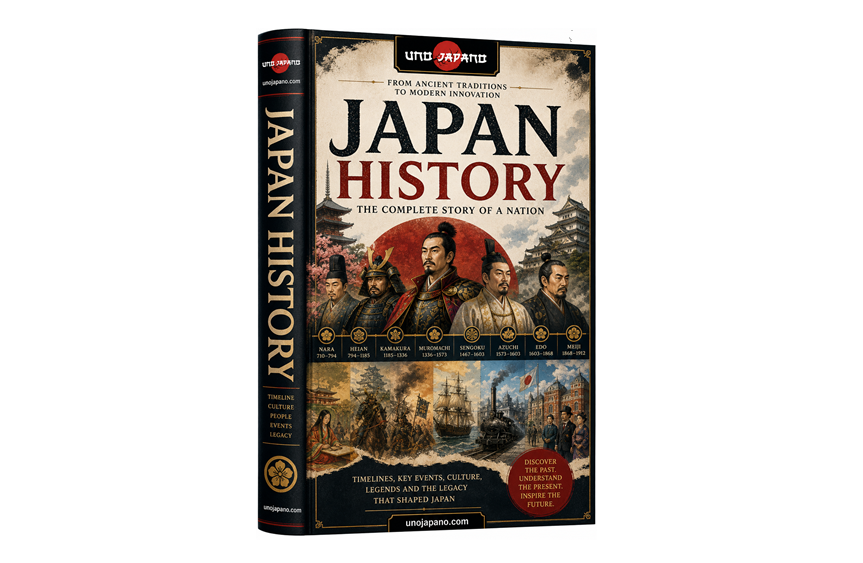
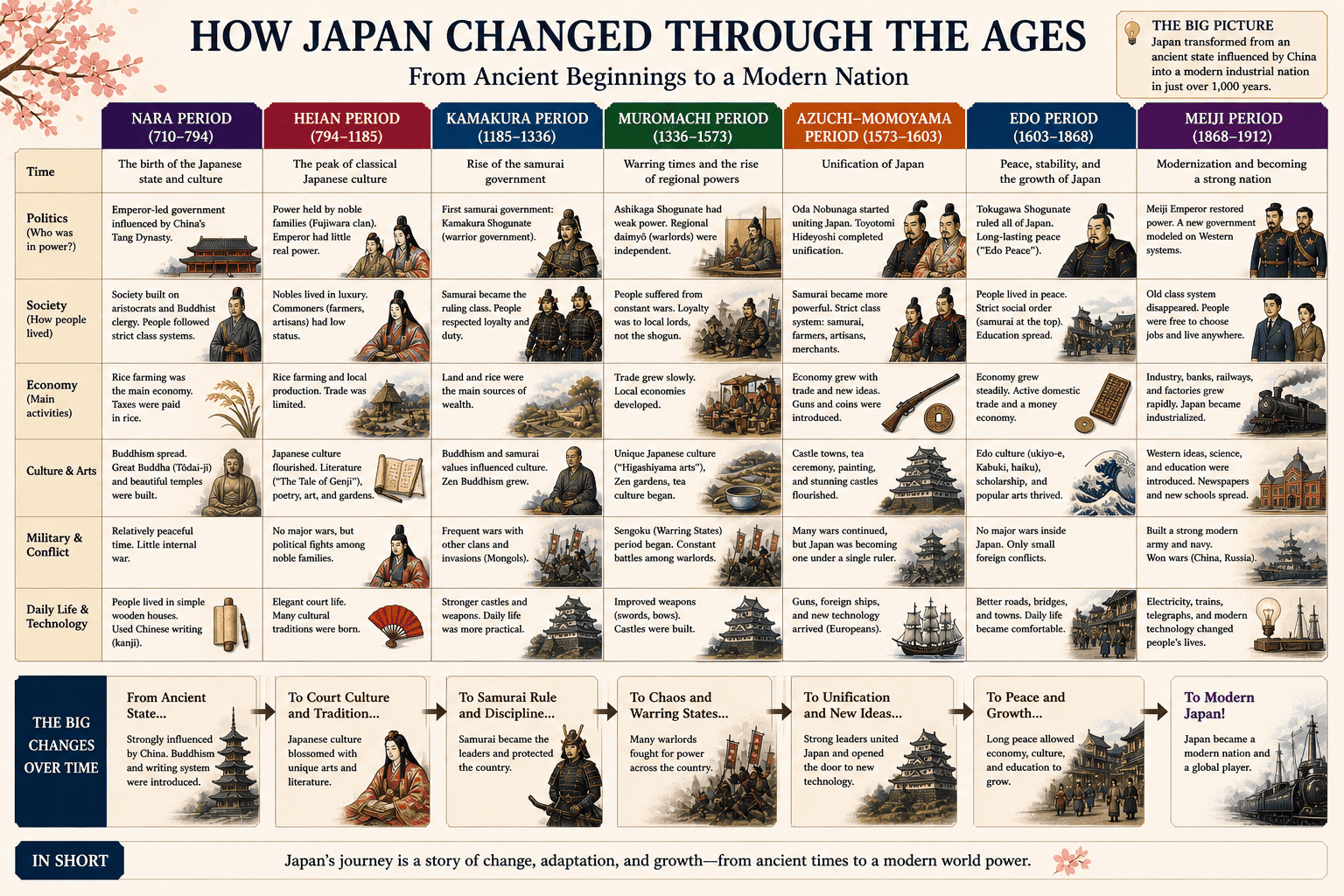
Japan’s history is a quiet tension between two forces: the Tenno (Emperor), seen as divine and symbolic, and the Shogun, who often held real political and military control. As we move through time, you’ll see how power shifts—but culture stays.
🌅 Nara Period (710–794)
Under Emperor Shōmu, Japan built its first real state centered in Nara. The people (kokumin) lived mostly from rice farming, paying heavy taxes to support the government and large Buddhist projects. The biggest event of this time was the spread of Buddhism, symbolized by the Great Buddha of Todaiji, as Japan tried to strengthen the country spiritually and politically.
Meanwhile, China’s Tang Dynasty was at its peak, heavily influencing Japan’s system, while Europe was in the early Middle Ages. Culture focused on religion and Chinese-style governance, and even today, temples and kanji writing remain from this era. However, Japan eventually abandoned the idea of copying China completely.
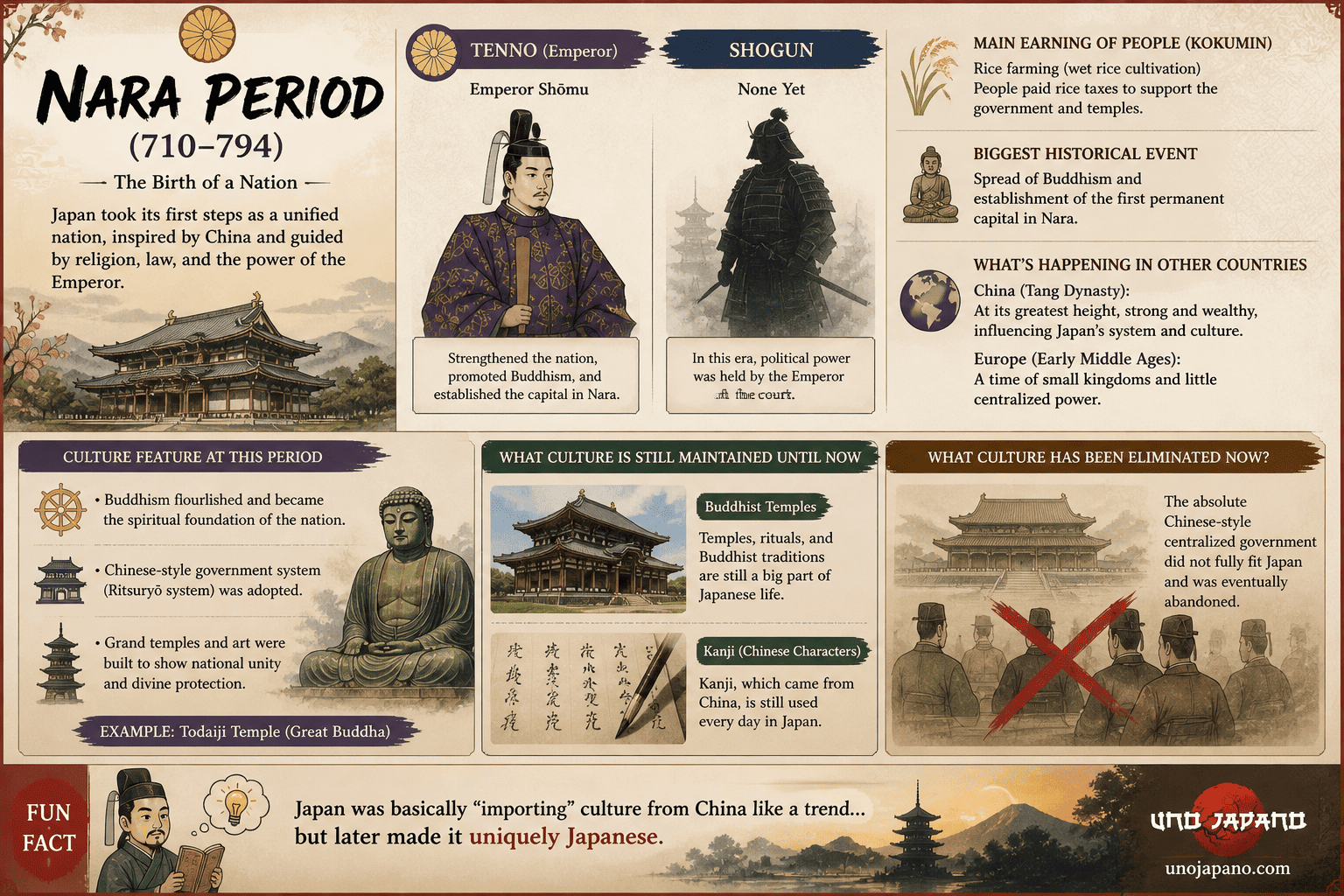
👉 Fun fact: Japan was basically “importing” culture from China like a trend—but later made it uniquely Japanese.
🌸 Heian Period (794–1185)
During the time of Emperor Kanmu and his successors, the capital moved to Kyoto, and Japan entered a golden age of aristocratic culture. While people still depended on agriculture, power shifted into private landowners’ hands, weakening the central government.
The biggest change wasn’t visible at first: samurai began rising in the background. While nobles enjoyed poetry and romance, real power was slipping away. At the same time, China declined after the Tang Dynasty, and Europe developed feudal systems.
This period gave birth to refined culture like The Tale of Genji, and traditions like aesthetics and writing systems still exist today. But aristocrats eventually lost their political control.

👉 Fun fact: While nobles were writing love poems, warriors were preparing to rule Japan.
⚔️ Kamakura Period (1185–1333)
With Minamoto no Yoritomo as the first Shogun, real power shifted to the military, even though Emperor Go-Toba still existed. Society remained agricultural, but now controlled by warriors.
The biggest event was the Mongol invasions, where Japan was saved by powerful storms—later called kamikaze (divine wind). At the same time, China was ruled by the Mongols, and Europe was fighting the Crusades.
This era shaped samurai culture and Bushido, which still influences Japanese discipline and mindset today. However, the idea of Emperor-led politics effectively disappeared.
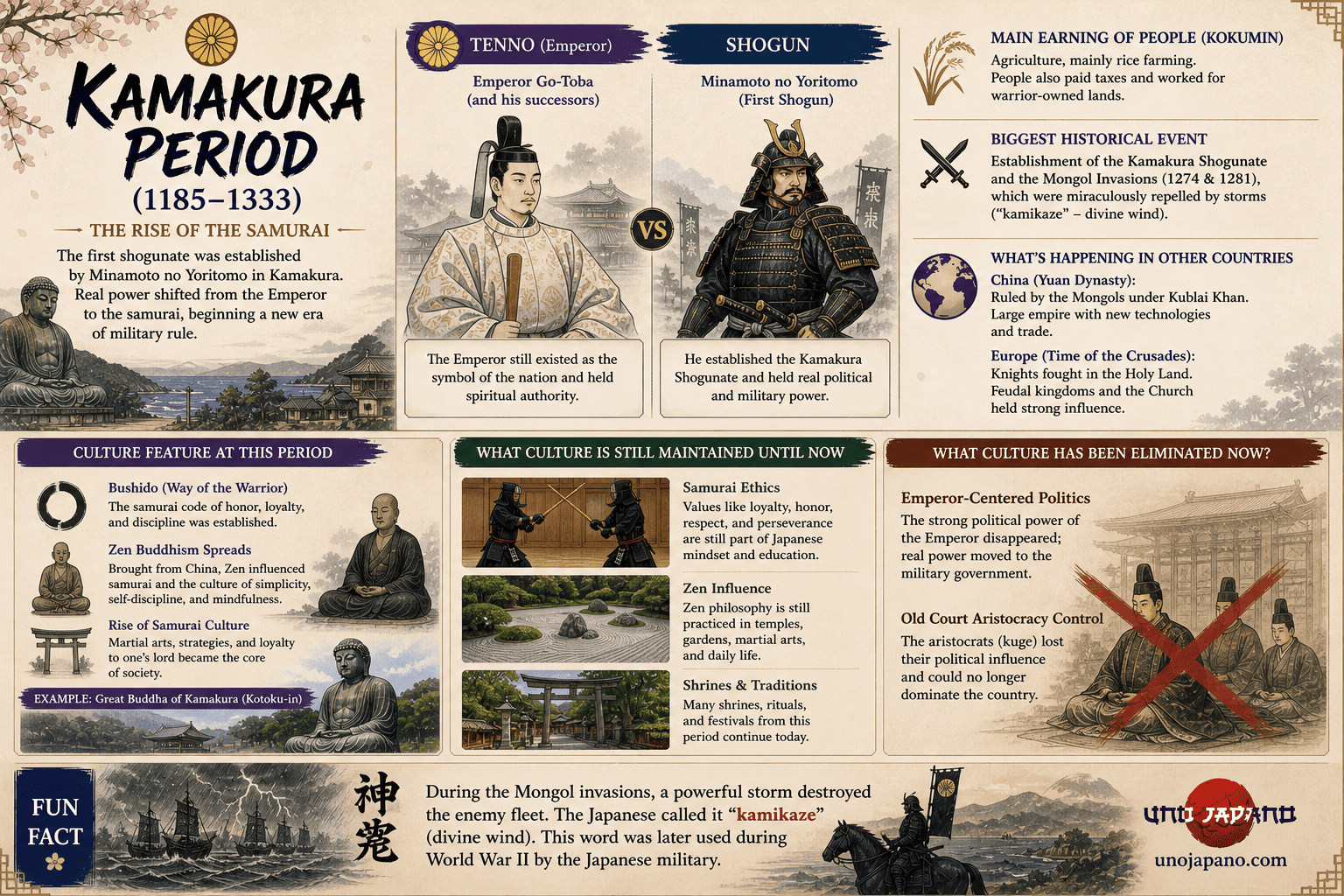
👉 Fun fact: Japan survived invasion not by army—but by weather.
🏹 Muromachi Period (1336–1573)
Under Shogun Ashikaga Takauji, Japan entered a time of contradiction: beauty and chaos. People still farmed, but instability from the Sengoku (Warring States) period made life uncertain.
While China’s Ming Dynasty thrived and Europe entered the Renaissance, Japan was in constant internal war. Yet from this chaos came culture: tea ceremony, Zen gardens, and Noh theater.
These cultural elements still define Japan today, even though stable government did not exist at the time.
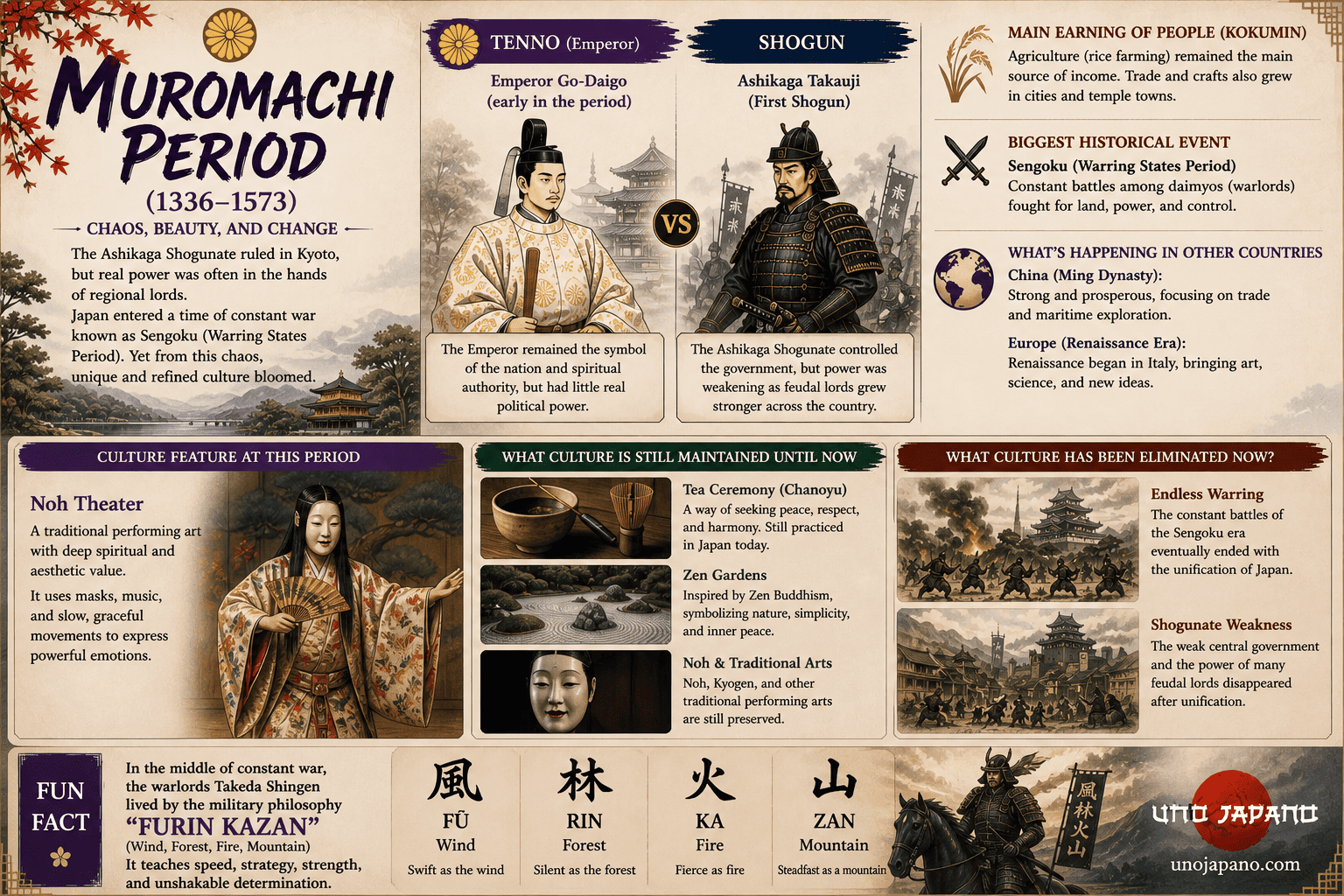
👉 Fun fact: Japan created its most peaceful art… during its most violent time.
🔥 Azuchi–Momoyama Period (1573–1603)
This was the age of unification under Oda Nobunaga and Toyotomi Hideyoshi, serving under Emperor Ōgimachi. People lived through farming and growing trade, as the country stabilized.
The biggest event was the unification of Japan, ending centuries of war. At the same time, Europeans arrived, bringing guns and Christianity, while Europe itself was exploring the world.
Culture became bold and powerful—castles, gold decoration, and Western influence. Independent warlords disappeared as Japan became one.
👉 Famous words: “If the bird does not sing, kill it.” — Oda Nobunaga
“If the bird does not sing, make it sing.” – Toyotomi Hideyoshi
“If the bird does not sing, wait for it to sing.” – Tokugawa Ieyasu
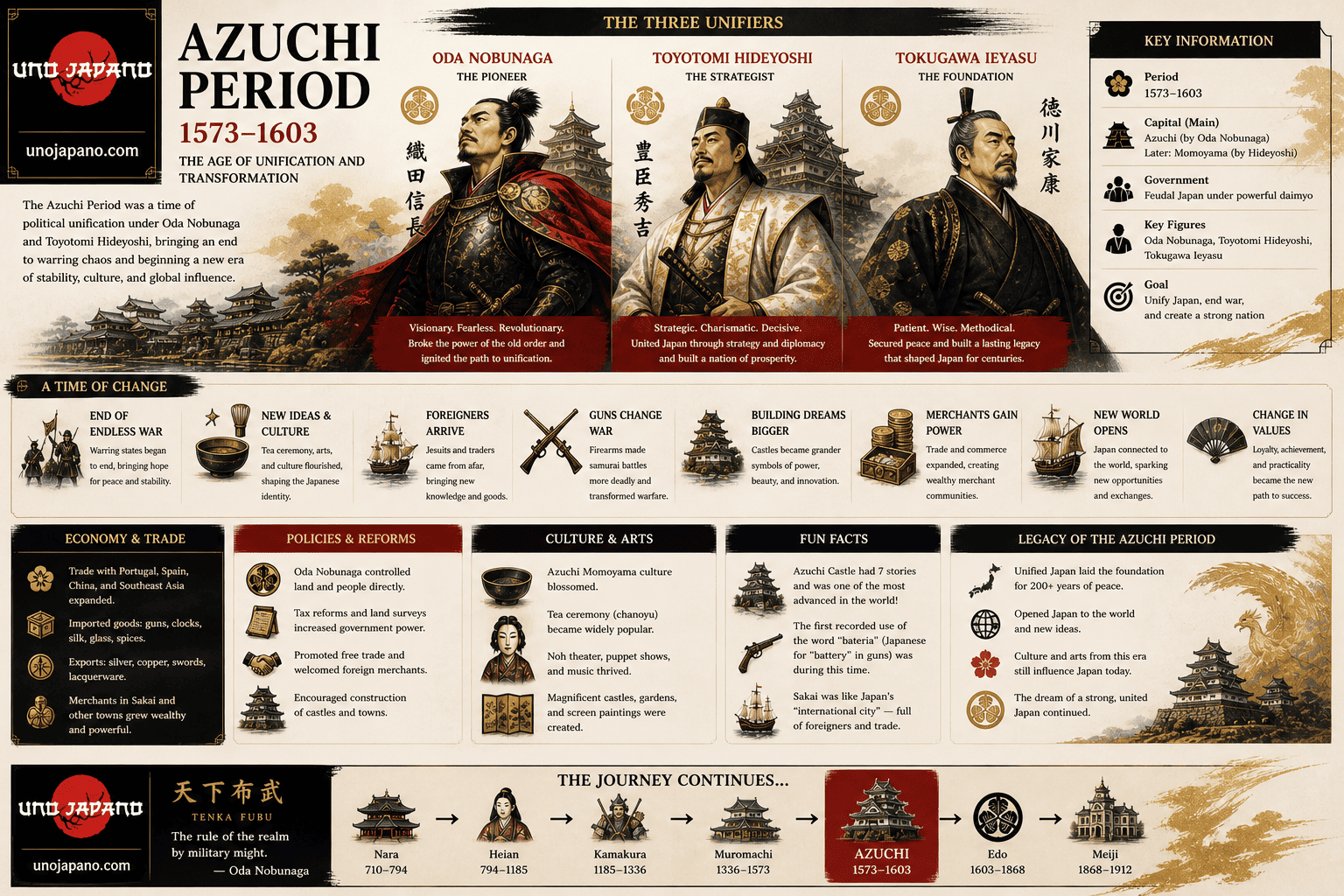
👉 Fun fact: Japan modernized warfare almost instantly after seeing European guns.
🏯 Edo Period (1603–1868)
Under Shogun Tokugawa Ieyasu and his family, Japan entered 250 years of peace, while emperors remained symbolic. People’s lives expanded beyond farming into commerce and urban work, especially in cities like Edo (Tokyo).
The biggest policy was sakoku (isolation), closing Japan off from the world. Meanwhile, China’s Qing Dynasty ruled, and Europe went through the Industrial Revolution.
Culture flourished: kabuki, ukiyo-e, and early sushi culture. Many of these remain today, but strict class systems like samurai superiority disappeared.
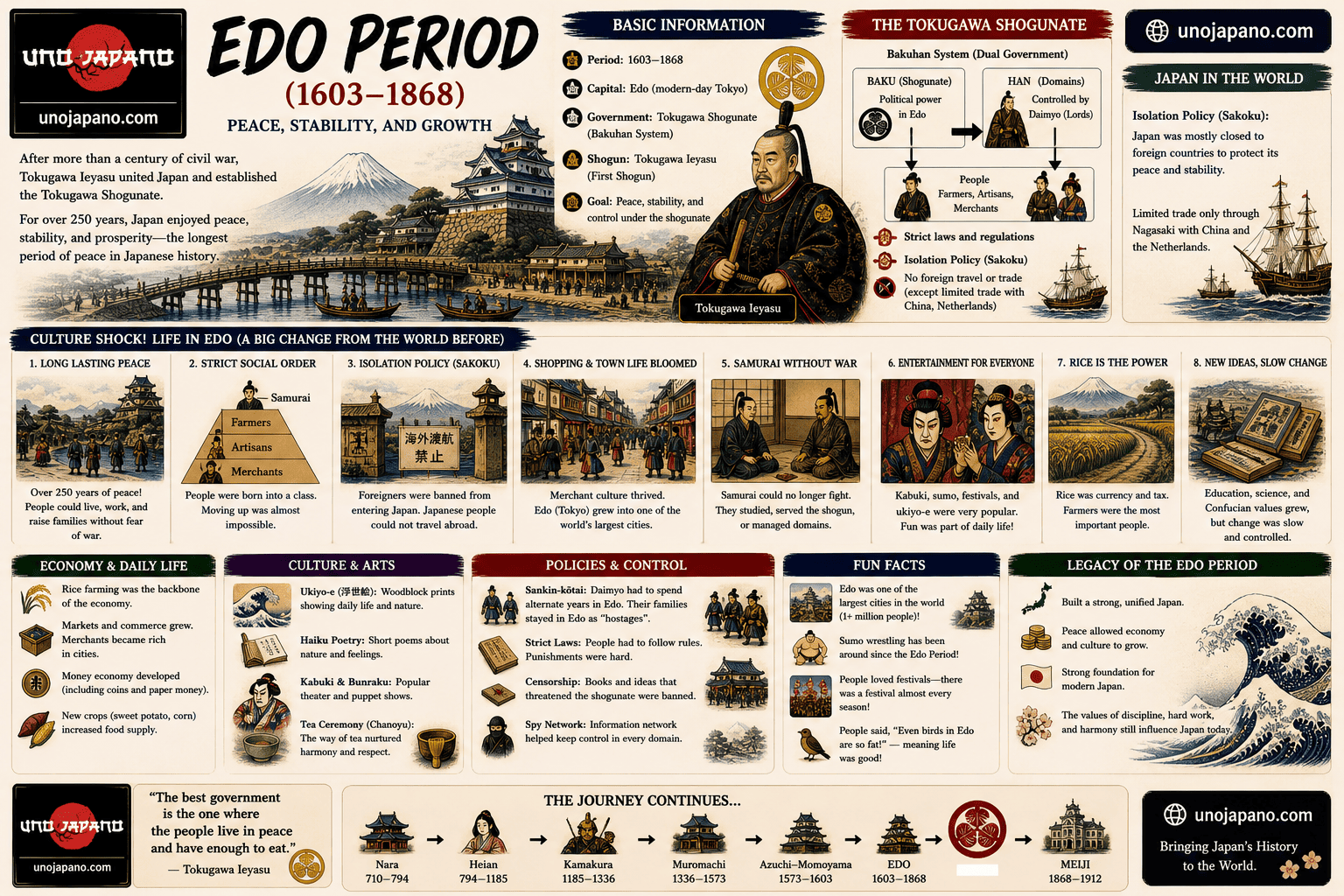
👉 Fun fact: Samurai became more like government officials than warriors.
⚡ Meiji Restoration (1868–1912)
Under Emperor Meiji, power returned to the Emperor, and the Shogunate ended. Japan rapidly transformed into a modern nation. People shifted from farming to industry and modern jobs.
The biggest change was modernization and Westernization, as Japan reacted to global pressure. While China weakened, and Europe dominated, Japan adapted quickly.
Modern systems, education, and industry from this time still exist today, while the samurai class was completely abolished.
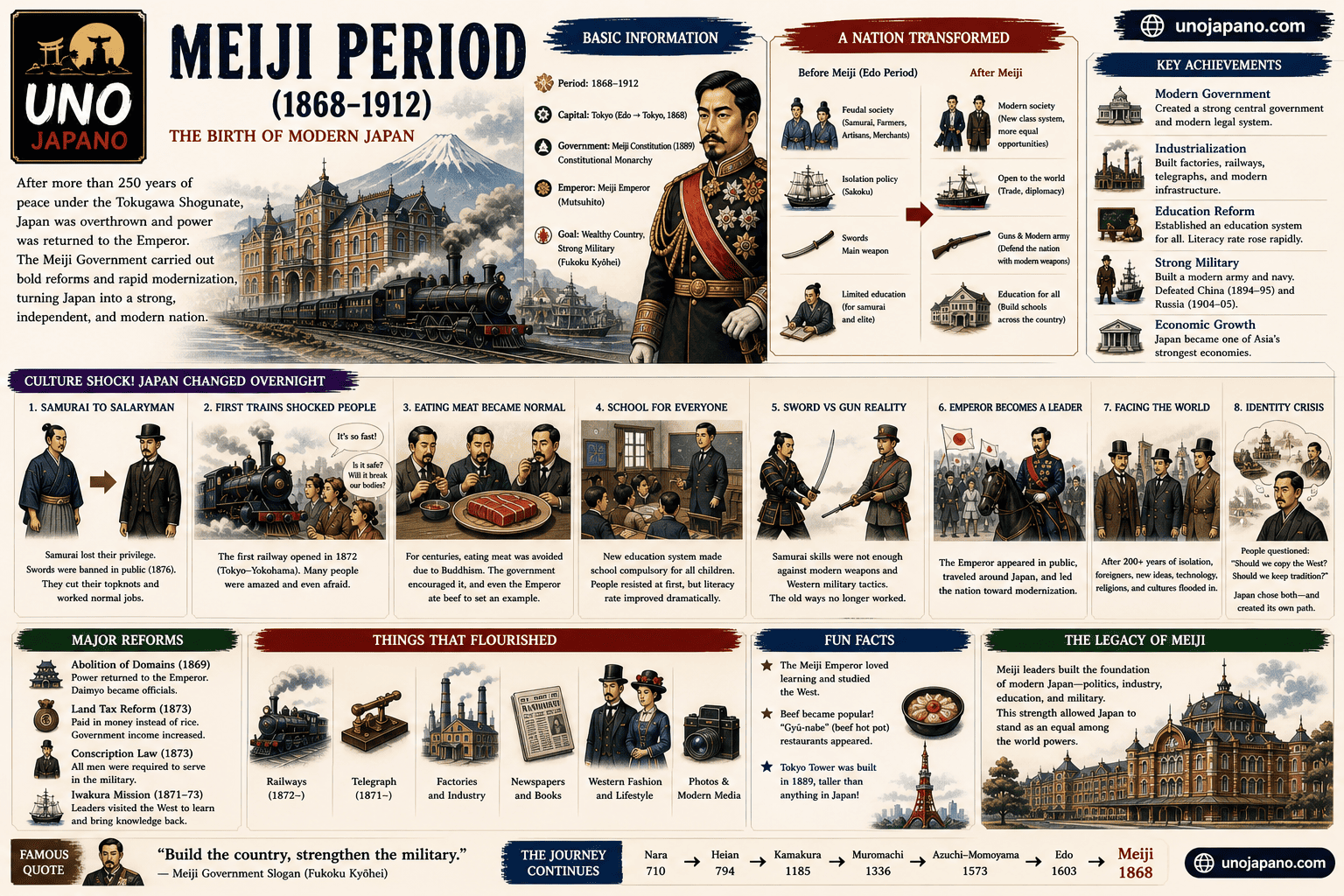
👉 Fun fact: In just a few decades, Japan went from swords to factories.
🎯 Summarize
Japan’s history isn’t just about who ruled—it’s about how power changed without breaking identity.
Even when the Shogun controlled armies…
they still ruled in the name of the Emperor.
And even as systems disappeared—
Japan kept its culture, refined it, and carried it forward.
FUNFACT “when was Japan among the most advanced in the world overall (economy + culture + innovation + society)”, there are really three standout peaks, each in a different way:
🥇 1. Heian Period (794–1185) — Cultural Superpower
This wasn’t about technology—it was about refinement and creativity.
Japan during Heian was arguably one of the most culturally advanced societies in the world:
- Produced the world’s first novel (The Tale of Genji)
- Developed its own writing system (hiragana)
- Created highly sophisticated court culture (poetry, fashion, aesthetics)
🌍 Compared to the world:
- China was still strong, but declining
- Europe was in the Dark Ages
👉 In terms of art, literature, and aesthetic philosophy, Japan was ahead of most of the world
👉 Weakness: politically fragile, not technologically advanced
🥈 2. Edo Period (1603–1868) — Stable, Educated Society
This is often underrated, but Japan became one of the most advanced societies in terms of everyday life.
Why it’s impressive:
- 250 years of peace (rare in world history)
- Very high literacy rate (even among common people)
- Strong urban culture (Edo was one of the largest cities in the world)
- Advanced arts and entertainment (kabuki, ukiyo-e)
🌍 Compared to the world:
- Europe was industrializing but also full of wars
- China was large but less socially dynamic
👉 Japan was NOT industrial yet, but in:
- Education
- Social order
- Urban life
…it was arguably ahead of many countries
👉 Weakness: isolated, missed early industrial revolution
🥇🥇 3. Post-WWII → 1980s (High Growth Era) — Global Leader
This is Japan at its absolute peak in modern world power.
Why this period stands out:
- Rapid economic growth → became world’s 2nd largest economy
- Global leader in technology and manufacturing
- Innovation in:
- Electronics (Sony, Panasonic)
- Automobiles (Toyota, Honda)
- Strong education system
- Cultural exports (anime, music, design)
🌍 Compared to the world:
- Competing directly with the United States and Europe
- Seen as the future model of success
👉 In the 1980s, many believed Japan would dominate the global economy
👉 Weakness: economic bubble → collapse in the 1990s
Read more about Japanese Culture
Join us for latest JLPT Answers at:
1/ Telegram Channel https://t.me/unojapano/
2/ Telegram Group Chat https://t.me/jlptlearnjapanesewithunojapano/
3/ Facebook Channel https://www.facebook.com/unojapano/
4/ Facebook Community https://www.facebook.com/groups/unojapano/
5/ Follow us via Twitter https://x.com/unojapano/