
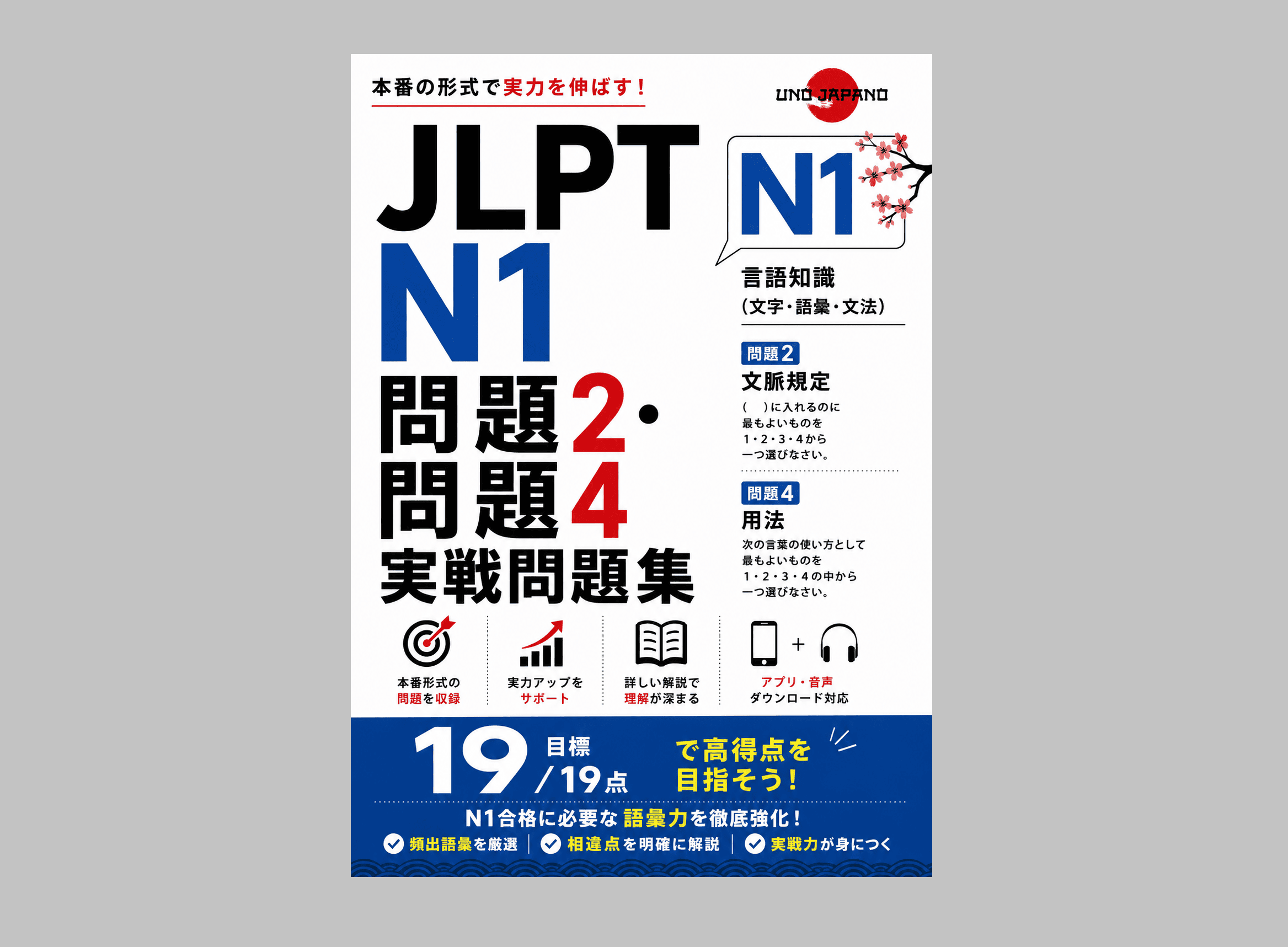
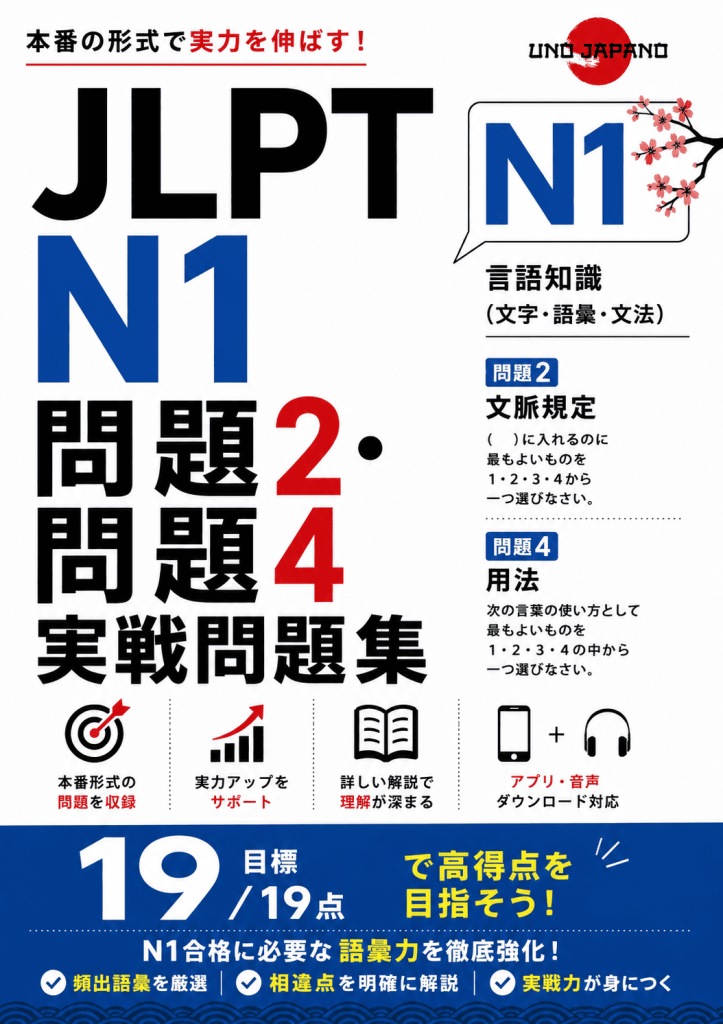
JLPT N1 問題2・問題4 実践問題集|文脈規定と用法で19点を目指す!
Password: unojapano.com
Preparing for the JLPT N1 requires more than memorizing long vocabulary lists. At the highest level of the Japanese Language Proficiency Test, learners must understand how advanced words are used in context, recognize subtle differences between similar expressions, and choose the most natural answer under strict time limits.
This practice book is designed specifically for learners preparing for the JLPT N1 Language Knowledge section, known in Japanese as:
言語知識(文字・語彙・文法)
Language Knowledge: Characters, Vocabulary, and Grammar
The book focuses on two important vocabulary question types:
- 問題2:文脈規定 — Contextually-defined expressions
- 問題4:用法 — Usage
These two question types can be challenging even for learners who already know many N1-level words. Knowing the dictionary meaning of a word is often not enough. To answer correctly, you must understand context, collocations, nuance, formality, and natural Japanese usage.
This book provides focused practice to help learners become familiar with these question formats and develop the vocabulary skills needed for the official JLPT N1 examination.
Understanding the JLPT N1 Language Knowledge Section
The JLPT N1 Language Knowledge section evaluates whether learners can understand advanced Japanese vocabulary, Kanji, expressions, and grammar.
For vocabulary questions, the exam does not simply ask whether you have seen a word before. It checks whether you can identify its meaning, understand how it functions inside a sentence, distinguish it from similar words, and recognize whether it is being used naturally.
The main vocabulary question types include:
Kanji Reading
This question type tests whether you can correctly read Kanji used in advanced vocabulary.
A word written in Kanji appears in a sentence, and you must select the correct Hiragana reading.
For example:
この地域では人口が急激に減少している。
You must recognize that 減少 is read as:
げんしょう
At N1 level, many Kanji words are formal, abstract, academic, or commonly found in news reports, business documents, essays, and professional communication.
Contextually-defined Expressions
This is 問題2, one of the main areas covered by this book.
You must choose the word or expression that best completes a sentence.
Paraphrases
This question type tests whether you can identify a word or phrase with a similar meaning.
You may understand the general meaning of a word, but you must also recognize which alternative expression has the closest meaning in the given context.
Usage
This is 問題4, the second main area covered by this book.
You are given a vocabulary word and must select the sentence in which that word is used most naturally and correctly.
問題2:Contextually-defined Expressions
The official instruction for 問題2 is:
( )に入れるのに最もよいものを、1・2・3・4から一つ選びなさい。
This means:
Choose the best answer from 1, 2, 3, and 4 to fill in the blank.
In this question type, a sentence contains a blank. Four vocabulary choices are provided, but only one fits the meaning and context naturally.
The challenge is that several choices may appear grammatically possible. Some may even have similar English translations. However, only one word will match the situation, tone, collocation, and intended meaning of the sentence.
Example of 問題2
その会社は経営方針を大きく( )することを発表した。
Possible answers:
- 展開
- 転換
- 移動
- 交換
The best answer is:
2. 転換
The complete sentence becomes:
その会社は経営方針を大きく転換することを発表した。
Meaning:
The company announced that it would significantly change its management policy.
Although several answer choices relate to movement or change, 方針を転換する is the natural combination in Japanese.
This question therefore tests more than meaning. It also tests whether you know which words are commonly used together.
What 問題2 Tests
Understanding Words in Context
A word may have several meanings depending on the sentence.
For example, the word 重い can describe something physically heavy, but it can also describe a serious illness, a heavy responsibility, a serious atmosphere, or slow computer performance.
In 問題2, you must use the surrounding sentence to determine which meaning is intended.
Collocations
Collocations are combinations of words that naturally appear together.
Examples include:
- 責任を負う — to bear responsibility
- 結論を下す — to reach or deliver a conclusion
- 方針を転換する — to change a policy
- 影響を及ぼす — to exert an influence
- 誤解を招く — to cause misunderstanding
A learner may know the meaning of every individual word but still choose the wrong answer if they do not recognize the natural combination.
Differences Between Similar Words
N1 vocabulary often contains words with related meanings.
For example:
- 変更 — change or alteration
- 変化 — change or transformation
- 転換 — shift or conversion
- 修正 — correction or revision
- 改善 — improvement
These words may all be translated as some form of “change,” but they cannot always be used interchangeably.
The correct choice depends on what is changing, why it is changing, and how the sentence is structured.
Formality and Register
Some words are mainly used in casual conversation, while others are more common in formal writing, business communication, academic texts, or news reports.
JLPT N1 sentences often use formal or written Japanese. Learners must recognize which expressions are suitable for the tone of the sentence.
Nuance
Two words may have almost the same dictionary definition but express different attitudes or emotional tones.
One word may sound neutral, while another sounds critical, indirect, respectful, forceful, or emotional.
These subtle differences are especially important at N1 level.
Why 問題2 Is Difficult
Many learners try to solve 問題2 by translating the whole sentence into their native language. This method can sometimes help, but it is not always reliable.
Several Japanese words may have the same English translation while being used differently.
For example, both 認める and 承認する can be translated as “approve” or “recognize.” However, their usage depends on the situation.
- 認める can mean to admit, recognize, accept, or permit.
- 承認する is more formal and often refers to official approval.
The JLPT may include answer choices with similar translations to test whether you understand these differences.
A better strategy is to study vocabulary through complete sentences rather than isolated word lists.
問題4:Usage
The official instruction for 問題4 is:
次の言葉の使い方として最もよいものを、1・2・3・4の中から一つ選びなさい。
This means:
Choose the sentence from 1, 2, 3, and 4 that uses the following word most appropriately.
In this question type, you are given one vocabulary word followed by four sentences. You must choose the sentence in which the word is used correctly and naturally.
This can be one of the most difficult vocabulary sections because the incorrect sentences may look almost correct.
A sentence may be grammatically correct but still use the target word unnaturally.
Example of 問題4
Target word:
促進
Possible sentences:
- この薬を飲むと、睡眠が促進して朝まで起きません。
- 政府は地域経済の発展を促進する政策を発表した。
- 彼は友達に旅行へ行くように促進した。
- 電車が遅れたため、駅まで急いで促進した。
The best answer is:
2. 政府は地域経済の発展を促進する政策を発表した。
Meaning:
The government announced a policy to promote the development of the regional economy.
促進する means to promote, accelerate, or facilitate the progress of something. It is commonly used with words such as:
- 発展を促進する
- 成長を促進する
- 理解を促進する
- 交流を促進する
- 利用を促進する
The other sentences do not use 促進 naturally.
What 問題4 Tests
Correct Meaning
First, you must know the meaning of the target word.
However, knowing a simple translation is only the beginning. Many N1 words have multiple meanings or are used differently depending on context.
Natural Sentence Patterns
You must understand the grammatical pattern in which the word is normally used.
For example, some words are commonly followed by:
- を
- に
- と
- から
- に対して
- に伴って
Choosing the wrong particle or sentence structure can make the usage unnatural.
Appropriate Subjects and Objects
Some verbs can only be used naturally with certain types of subjects or objects.
For example:
問題を解決する
is natural because a problem can be solved.
However:
食事を解決する
is unnatural because 食事 is not normally something that is “resolved.”
The grammar may look correct, but the meaning does not match the normal usage of the verb.
Transitive and Intransitive Usage
Many Japanese words are easily confused because of transitive and intransitive differences.
For example:
- 変わる — something changes
- 変える — someone changes something
- 高まる — something increases
- 高める — someone raises something
- 深まる — something deepens
- 深める — someone deepens something
A sentence may contain the correct general idea but use the wrong verb form.
Positive and Negative Nuance
Some vocabulary is generally used for positive situations, while other words are commonly used for negative situations.
For example:
- 改善する usually describes making something better.
- 悪化する describes something becoming worse.
- 貢献する has a generally positive meaning.
- 妨げる describes preventing or obstructing something.
Understanding these tendencies can help you eliminate incorrect choices.
Formal and Informal Usage
Many N1 words are used mainly in formal or written contexts.
A word may be natural in a newspaper article but sound strange in an everyday conversation between friends.
問題4 often tests whether the word matches the setting and style of the sentence.
The Difference Between 問題2 and 問題4
Although both question types test vocabulary knowledge, they require different skills.
In 問題2, you are given a sentence with a blank. You must decide which word fits the sentence best.
The main question is:
Which word naturally completes this context?
In 問題4, you are given a target word and four complete sentences. You must identify which sentence uses the word correctly.
The main question is:
In which sentence is this word used naturally?
問題2 mainly tests your ability to select vocabulary based on context.
問題4 tests whether you fully understand the target word’s meaning, grammar, collocations, nuance, and restrictions.
Studying both question types together can help you build deeper and more practical vocabulary knowledge.
About This JLPT N1 Practice Book
This book is designed to provide focused practice for learners who want to improve their performance in JLPT N1 問題2 and 問題4.
Rather than covering every part of the JLPT, the book concentrates on two vocabulary areas where many advanced learners lose points.
Through repeated practice, learners can become more familiar with the official question format and develop a faster, more reliable method for selecting answers.
The exercises are intended to help learners:
- Understand advanced vocabulary through context
- Recognize natural Japanese collocations
- Distinguish between words with similar meanings
- Identify incorrect or unnatural vocabulary usage
- Improve awareness of formal and written Japanese
- Build confidence with JLPT-style multiple-choice questions
- Increase both accuracy and answering speed
This focused approach can be especially useful during the final stage of JLPT N1 preparation.
Who Should Use This Book?
This practice book is suitable for learners who already have an upper-intermediate or advanced level of Japanese.
It may be particularly useful for students who:
- Are preparing for the official JLPT N1 examination
- Have already studied N1 vocabulary but struggle with usage
- Often confuse words with similar meanings
- Understand words individually but cannot use them naturally
- Lose points in 問題2 or 問題4
- Want more targeted vocabulary practice
- Need to improve speed before the examination
- Previously failed N1 and want to strengthen weak vocabulary areas
Learners who are still studying N3 or early N2 material may find some of the vocabulary difficult. This book is most effective when used after building a basic N1 vocabulary foundation.
How to Use This Book Effectively
Answer Without Using a Dictionary First
When completing the exercises, try to answer each question without immediately checking a dictionary.
This allows you to test your real exam ability.
During the official JLPT, you cannot use study materials, translation tools, or dictionaries. Your first answer therefore provides useful information about your current vocabulary level.
Review Every Answer Choice
Do not only check whether your answer is correct.
Study all four choices and ask:
- Why is the correct answer natural?
- Why are the other choices incorrect?
- Is the meaning wrong?
- Is the collocation unnatural?
- Is the grammar pattern incorrect?
- Does the word have the wrong nuance?
- Is the level of formality inappropriate?
Understanding why an answer is wrong is often more valuable than simply memorizing the correct answer.
Record Useful Collocations
Create a vocabulary notebook for common word combinations.
Instead of writing only:
影響 — influence
write:
影響を与える — to influence
影響を受ける — to be influenced
影響を及ぼす — to have an effect on
大きな影響 — a major influence
悪影響 — a negative influence
This approach helps you prepare for both 問題2 and 問題4.
Create Your Own Example Sentences
After learning a word, write one or two original sentences.
This helps confirm whether you really understand how the word is used.
Compare your sentence with examples from reliable Japanese dictionaries or authentic Japanese sources.
Review Similar Words Together
Study easily confused vocabulary as a group.
For example:
- 維持する — to maintain
- 保存する — to preserve or save
- 保管する — to store
- 保持する — to retain or hold
- 継続する — to continue
Comparing similar words makes their differences easier to remember.
Practice Under Time Limits
JLPT N1 requires both knowledge and speed.
After becoming familiar with the exercises, complete a group of questions under a time limit. Avoid spending too long on one difficult item.
When you are uncertain, eliminate obviously incorrect answers and select the most natural remaining option.
Common Mistakes to Avoid
One common mistake is choosing an answer only because the word looks familiar. Familiarity does not mean the word fits the sentence.
Another mistake is translating every option directly into English. Translation can hide important differences in usage.
Learners also sometimes ignore particles and sentence patterns. However, these details often reveal the correct answer.
Finally, many students check only the correct answer and move on. Without understanding the incorrect choices, they may repeat the same mistake in another question.
The best way to improve is to analyze each question carefully and identify the specific reason behind every error.
Building Practical N1 Vocabulary Skills
The vocabulary tested in JLPT N1 is commonly found in newspapers, essays, academic writing, formal discussions, workplace documents, public announcements, and professional communication.
For this reason, studying 問題2 and 問題4 is useful not only for passing the JLPT.
These exercises can also help learners:
- Read Japanese news more accurately
- Understand formal documents
- Follow advanced discussions
- Write more naturally
- Communicate more precisely
- Recognize differences in tone and nuance
A learner who understands how words are used in context will have stronger practical Japanese than someone who has only memorized translations.
Final Thoughts
JLPT N1 問題2 and 問題4 require a deep understanding of Japanese vocabulary.
To succeed, learners must go beyond memorizing individual meanings. They need to recognize natural collocations, understand subtle differences between similar expressions, identify appropriate sentence patterns, and judge whether a word fits the context.
This practice book offers focused training for:
問題2:Contextually-defined expressions
and:
問題4:Usage
By completing the exercises, reviewing every answer choice, recording useful word combinations, and repeating difficult questions, learners can gradually improve both accuracy and speed.
No single book can guarantee success in the JLPT N1 examination. However, targeted practice can help you identify weak areas and use your study time more effectively.
For learners who already have an N1 foundation but need additional practice with vocabulary in context, this book can be a valuable resource during both long-term study and final exam preparation.
Password: below title of the article
Join us for latest JLPT Answers and more Japanese Learning Resources at:
1/ Facebook Channel https://www.facebook.com/unojapano/
2/ Facebook Community https://www.facebook.com/groups/unojapano/
3/ Telegram Channel https://t.me/japanesefreedashboard/
4/ Telegram Group Chat https://t.me/freejapanesetalk/
5/ Follow us via Twitter https://x.com/unojapano/